The Commercial Collapse of Traditional Organic Search
%20(16).jpg)
Published:
January 22, 2026
Updated:
January 26, 2026
The digital marketing service sector is currently undergoing its most aggressive structural pivot in a decade. We are witnessing the systematic dismantling of the keyword-based economy. For fifteen years, the contract between brand and search engine was simple: you provide content, they provide traffic. That contract is being voided. The emergence of generative search platforms is not just a new channel; it is a fundamental displacement of the organic click.
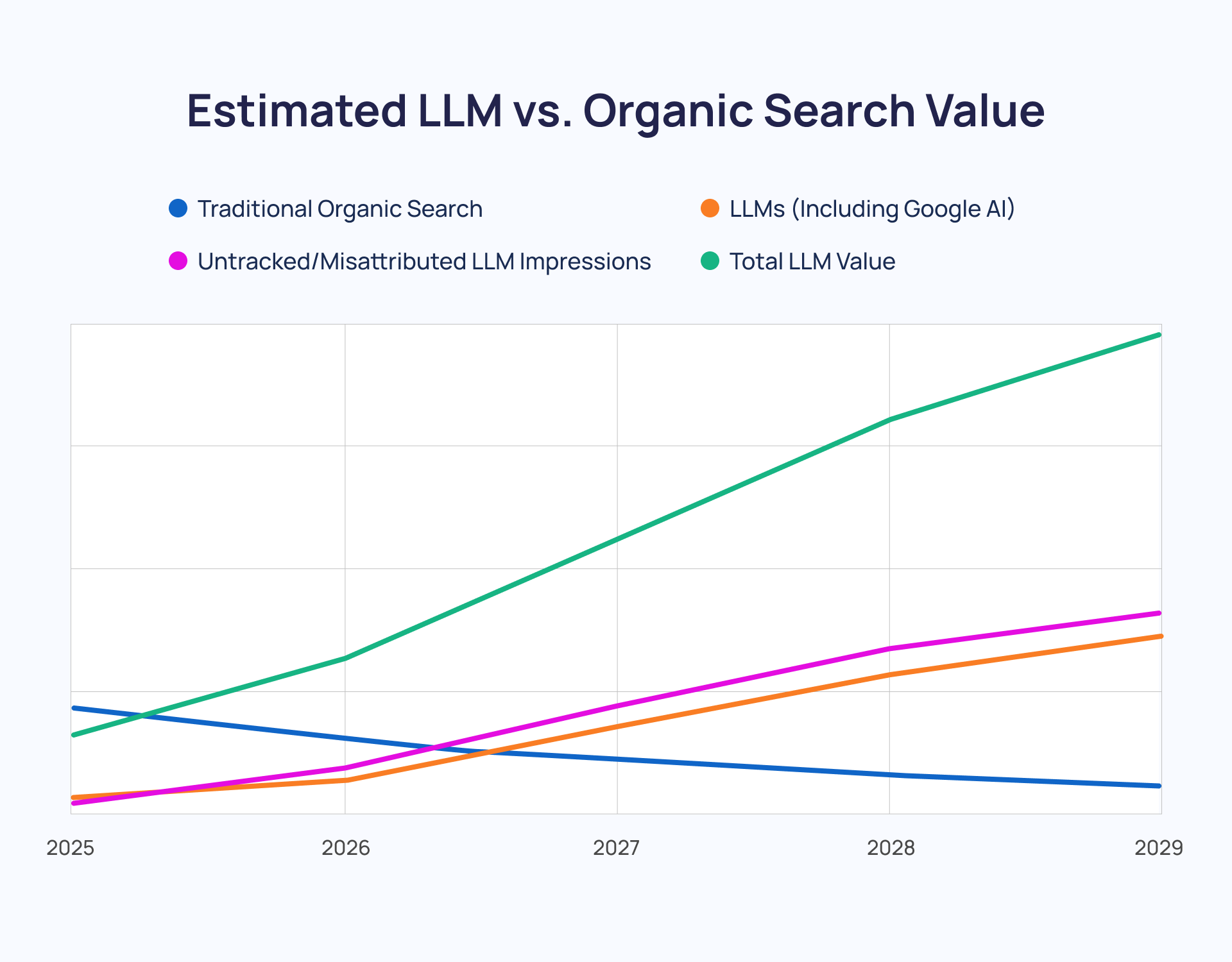
Intelligence scans confirm that leading agencies are already restructuring their service lines to address a reality where traditional organic search volume drops significantly by 2028. This is not a distant speculation. The immediate integration of "Generative Engine Optimization" (GEO) into agency scopes indicates that client anxiety is already forcing a change in how retainers are structured. We are moving from an era of ranking for visibility to an era of optimization for citation.
For founders and media buyers, the implication is stark. If your growth model relies on top-of-funnel organic traffic feeding a conversion page, your unit economics are about to deteriorate. The user journey is shortening, and the interface is becoming the destination. The question is no longer how to get the user to your site, but how to ensure the machine recommends your product when the user never leaves the chat window.
The Mechanics of the Shift: From Keywords to Entities
The most critical development in the last 48 hours is the operational shift among elite agencies from keyword optimization to "entity building." In the legacy model, we optimized for strings of text. In the generative model, we must optimize for concepts and relationships. Large Language Models (LLMs) do not retrieve websites based on backlink volume alone; they construct answers based on the semantic authority of a brand within a specific knowledge graph.
This explains why agencies are scrambling to bundle "search everywhere" optimization. They are moving away from tracking a number one position on a results page—which may not exist in a chat interface—and toward tracking "share of citation." The metric of success is shifting from click-through rate to mention rate. If a user asks a generative engine for the "best enterprise CRM," and the engine synthesizes an answer that lists your competitor but excludes you, you have lost the customer before a search query was ever logged.
Furthermore, the introduction of protocols enabling autonomous agents to complete purchases—such as the recent integration between payment processors and major LLM providers—signals the arrival of "Agentic Commerce." We are approaching a state where software agents, not humans, execute the transaction. In this environment, visual persuasion and landing page copy matter less than the structured data and inventory feeds that allow a machine to verify your product's existence and price.
The Economics of Zero-Click Discovery
The industry forecast suggests that up to 25% of search volume will migrate to chat-based interfaces and virtual agents within two years. Commercially, this is a disaster for thin content and affiliate models. If the engine provides the answer directly, the publisher receives no traffic. The "ten blue links" are being replaced by a single synthesized answer, effectively creating a winner-take-all environment for brand visibility.
This shift forces a decoupling of performance metrics. Agencies are reportedly building custom reporting suites to track referral traffic from these new sources, but the reality is that attribution will become opaque. The "zero-click" phenomenon means that brand awareness will increase while measurable site sessions decrease. For a CMO justifying a budget, this creates a massive attribution gap. You may be paying for "visibility" that never registers in Google Analytics.
The winners in this new ecosystem are brands that own their proprietary data and have invested in high-quality, structured content that LLMs can easily ingest and cite. The losers are the middlemen—comparison sites, aggregators, and generic content farms—whose value proposition is summarizing information that a generative engine can now synthesize instantly and for free.
The Aragil Perspective
If we were advising a client today on this shift, our immediate counsel would be to freeze any new spending on generic "SEO audit" packages that focus on legacy keyword density. Those are rapidly becoming depreciating assets. Instead, capital should be reallocated toward technical infrastructure and structured data.
We would immediately audit the brand's "entity status." Is the brand clearly defined in knowledge graphs? Is the product inventory accessible via clean APIs and schema markup? The goal is to make the brand machine-readable. If a generative engine cannot understand your pricing, availability, and reviews through structured code, you are invisible to the agentic buyer.
We would also warn against the inevitable wave of "GEO experts" selling unverified optimization services. The feedback loops for these new engines are not yet fully understood, and metrics like "96% accuracy in reverse-engineering" should be viewed with extreme skepticism. The mistake most teams will make is trying to "game" the LLM with keywords, rather than building the authority signals (E-E-A-T) that these models actually prioritize.
Monitor your branded search volume closely. As generative discovery rises, unbranded organic traffic will fall, but branded intent should remain stable or grow. If you see a decline in users searching for your brand specifically, you are losing relevance in the generative layer.
Conclusion
The era of easy organic acquisition is closing. The pivot to generative search is not a feature update; it is a platform migration. We are moving from a search economy, where users hunt for information, to an answer economy, where machines curate reality.
Founders must accept that their website is no longer the front door. It is the back office. The front door is now a chat interface controlled by a third-party algorithm. The brands that survive will be those that build enough authority to be cited by the machine, and enough loyalty to be sought out by the human, regardless of what the algorithm suggests.